I've learned more by guiding health professionals into the Himalayas than in my thirty years of training and practice in psychology (well, sort of!).
In the Himalayas, our comforts are stripped away. The altitude makes one's head spin. The beds, sanitation, and cold stone rooms can be miserable. Every day is spent sweating up and down thousands of metres of mountain.
And what did I discover? In that rare air, folks who think too much spiral into stress and fear. We often hate asking for help because we feel weak!!
Here's what I've learned:
🌍 Alone, we die; together, we thrive.
Our key to survival is:
👋Relying on others
🗣️Asking for help
💔Being vulnerable
🥾 Walking the path together
Your clients are climbing a mountain too - LIFE.
They cannot do it alone.
Climbing the mountain of life
Psychotherapy is individualistic. Therapy models favour self-esteem, self-worth, self-concepts, your thoughts, your feelings, your actions.
But we are a group species, and there is a social world that lies within us all.
Have you ever been home alone, looked around your messy room, and said to yourself, "I better tidy up or people will think I'm a slob"? Even when there are no people home to see your mess!
That's your social world influencing you from within.
Everything you do is influenced by others.
The clothes you wear? What you study? Your career choices? Even your reading preferences or gardening style? All are shaped by others.
Does your therapy elevate the social context within an individual?
- Consider if most of your therapy time is spent on self-concepts, self-growth, self-esteem, self-blame, or self-criticism?
- Do you help clients see social views, social concepts, social patterns and the social world they carry within them?
- Do you consider how every thought, feeling and action we take has arisen from our interdependence with others?
If your favourite therapy model is a tad too individualistic, perhaps it's time to expand it.
Help them 'Walk with Others'
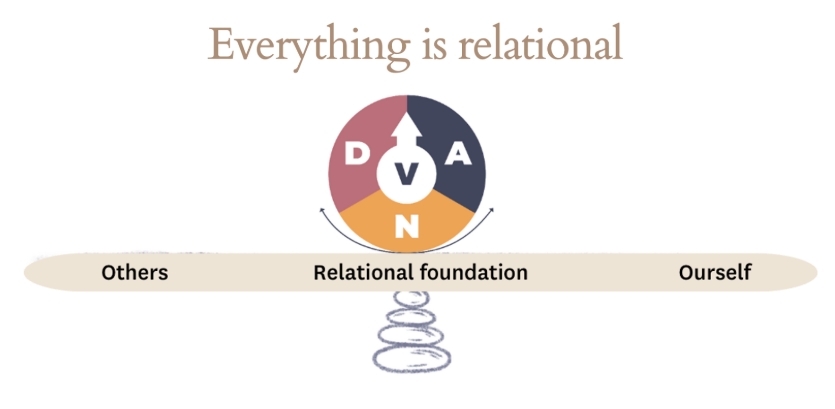
When Joseph Ciarrochi and I developed the DNA-V model, an adaptation of ACT, we knew that the social relata were essential. We nested the individual within their social context because we saw that every thought, feeling, or action we have arises from our interactions with other people.
Social is the relational context in which we all learn to think, feel, and respond. After all, what is a self-concept if there are no others to teach it, see it, accept it, or judge it?
Your social context is carried within you.
Therapy is learning to balance self and social, and it might look like this:
©Images from What Makes You Stronger.
Reimagining therapy through a relational lens:
-
If you use the DNA-V model as a guide, consider all of your client's thoughts, feelings, actions, and values through both a self and social contextual lens.
-
Help clients recognise their social patterns through their history of learning via others. What patterns do they reenact today?
-
Balance self-focused and socially-focused session time. Does your client spend their sessions exploring their self-concepts, or exploring what other people think or want? Balance this. Create flexibility between the individual and their social view.
-
In session, practice perspective-taking across both self and social domains and build flexibility wherever you see rigid rules about self and others.
-
Consider self and others: Sometimes we need to ask for help; sometimes we work it out for ourselves. Sometimes we need to show inner strength; sometimes vulnerability.
-
Discuss values across 'me and we':
-
Help shape their values as an individual (How I want to be)
-
In their actions towards others (How I want to act in my friendships)
-
What they value in relationships (I care about honesty)
-
What they value in their broader communities (I care about a world that is ….)
-
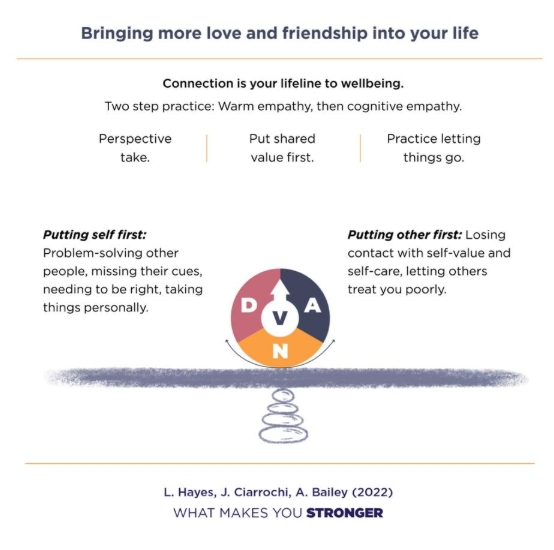
In our book, What Makes You Stronger (the print version is best) self and social are central. Just as you see here in this memory prompt on friendship:
Consider how your therapy sessions could look different if you truly embraced an interdependent perspective.
©Images from What Makes You Stronger.
Warmly,
Dr. Louise Hayes
Upcoming Training, Courses & Mentorship
Join the waitlist for Therapist Adventures 2026
Express Interest in 1:1 Supervision & Consultation
Coming Soon
- Trauma-Informed Therapy for Youth Course
- Engagement, Assessment & Planning with Young People Course
Mindful Adventures 2026
Join Mindful Adentures November 2025