Here's something nobody tells you about developing expertise: As you get better, self-doubt often gets worse, not better.
This seems backwards, doesn't it? Shouldn't increased skill lead to increased confidence?
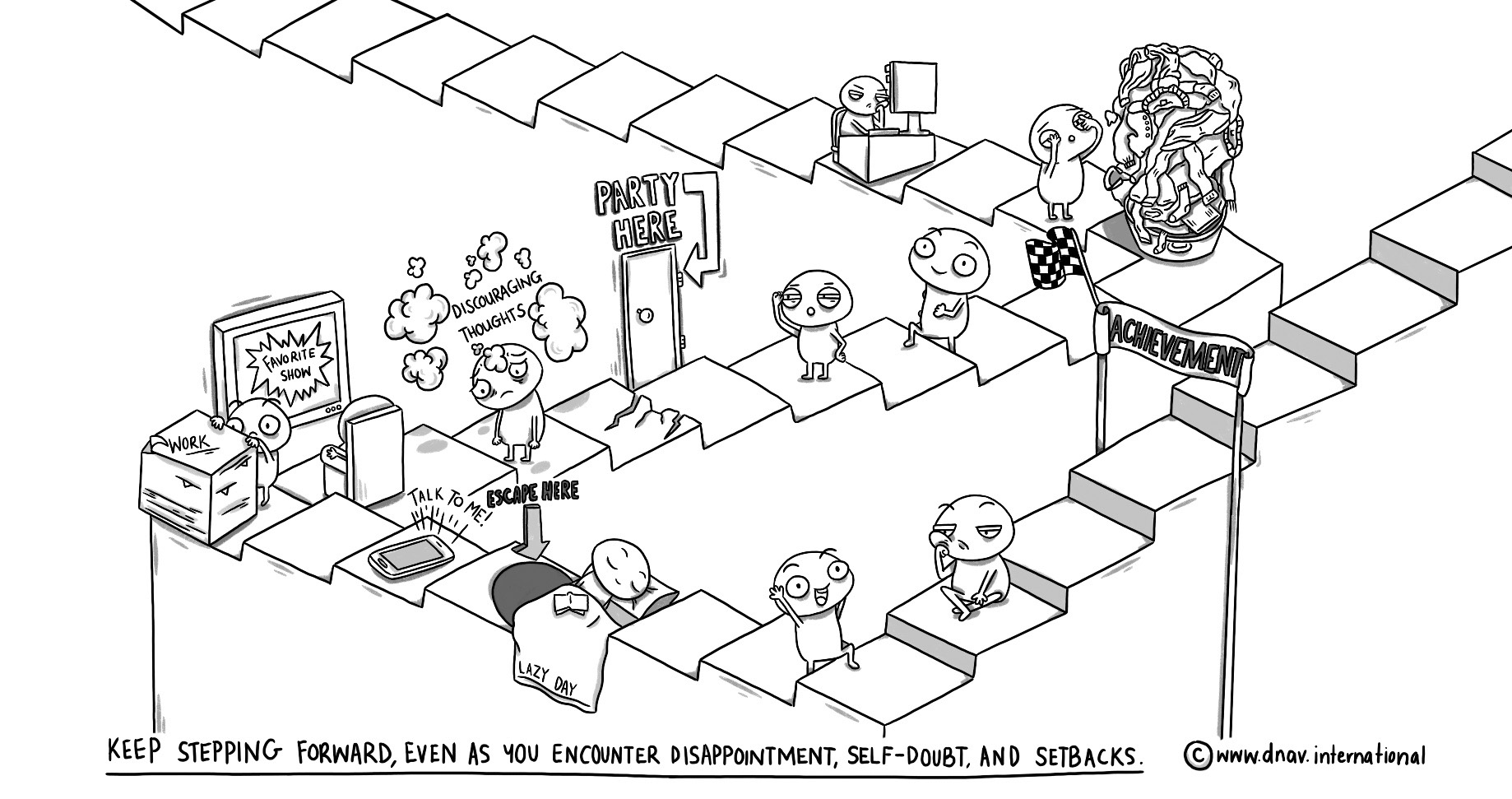
But look at the illustration —that staircase of achievement.
Each step up represents improvement from deliberate practice or study. And what do you see alongside those steps?
Thoughts and feelings that fluctuate wildly.
Some days: confidence, motivation, flow.
Other days: self-doubt, insecurity, feeling like a fraud.
Here's why this happens:
When you push yourself to improve, you increase the risk of mistakes and setbacks. You're attempting things you can't yet do smoothly. You're making your weaknesses visible—to yourself, to supervisors, sometimes to
clients.
More challenge = More opportunity for self-criticism.
The mistake most therapists make: They think self-doubt means they're on the wrong path. They interpret insecurity as evidence they should stop, go back to what's comfortable, or that they're not "meant" to develop this particular skill.
But self-doubt is actually a signal that you're in your discovery zone—exactly where growth happens.
Here's what you need to understand:
You don't have control over your thoughts and feelings. When you're stretching yourself, your advisor will throw self-doubt at you. That's what advisors do. They're trying to protect you from the vulnerability of looking
incompetent.
What you DO have control over is your practice. Your showing up. Your hands and feet moving toward your goals.
The experts—the truly masterful clinicians—still experience self-doubt and low motivation. They haven't eliminated these feelings. They've simply learned not to let them determine whether they practice.
Think about the therapist whose workshop you attended, whose approach transformed your thinking. Do you imagine they never doubt themselves? That every session feels confident and smooth?
They have the same internal experiences you do. The difference is they keep practicing anyway.
The illustration shows it clearly: Achievement isn't a smooth upward climb where you feel progressively more confident. It's a staircase where your internal experience varies wildly—confidence here, doubt there, motivation today, resistance tomorrow—but the steps keep going up.
What this means practically:
Expect self-doubt when you're learning something new. It's normal, not a sign of failure.
Notice when your advisor says "You're not good at this" or "Everyone can see you're struggling." That's just your advisor doing its protective thing.
Your confidence will fluctuate. That's expected. Don't make practice decisions based on how confident you feel.
Motivation will come and go. The experts practice even when they don't feel motivated.
The key insight: Mistakes and self-doubt are not obstacles to achievement. They're part of the process. They're the price of admission to the discovery zone.
When you feel self-doubt creeping in during practice, that's not evidence you should stop. It's evidence you're exactly where you need to be—at the edge of your current capability, which is the only place growth happens.
Keep showing up. Keep practicing deliberately. Have faith that your efforts will elevate you, even when your internal experience is messy and uncertain.
The staircase goes up regardless of how you feel on any given day.
Hope to speak to you soon,
Louise Hayes, PhD
Self-doubt is normal, but navigating it alone makes the path harder than it needs to be. Having experienced guidance through the messy middle of development changes everything.
If you're ready for that support, it's your last chance to book in your call with Louise.
👉 Book Your 1:1 Chat with Louise
Learn more about Training, Courses & Mentorship




Click here to learn more about Therapist & Mentoring Adventures
*From: Hayes, L. L., Ciarrochi, J. V., & Bailey, A. (2022). What Makes You Stronger: How to Thrive in the Face of Change and Uncertainty Using Acceptance and Commitment Therapy. New Harbinger Publications.