We are meant to detect stress, to respond, and to survive
Let's talk about our innate learning first.
When a monkey senses a threat, its initial reaction is to seek protection from its group. If the monkey's family comes to the rescue, it’ll go back to swinging from trees. But if it must face the danger alone, its body will flood with adrenaline, and it’ll prepare to fight or flee. This takes a lot of energy, so a happy monkey is one that doesn’t need to go into heightened stress too often.
Humans have these adaptive responses, too. As an infant, if you felt unsafe, you'd put your arms out, fuss, or cry to get picked up; that's calling on your group for help. If support didn't come quickly, you could escalate, with louder crying, more distress. And, if soothing was absent, you could withdraw and close down. (1)
These are our initial physiological responses, but then the world expanded.
Learning happens in every moment
It is easy to assume that humans have more general intelligence than chimpanzees. But when researchers (2) tested a group of orangutans, chimpanzees, and human toddlers on problem-solving tasks, they found that the primates could perform some tasks as well as humans. The chimps were especially good at tasks involving the physical world, such as spatial skills. But we humans excelled at one special ability – social imitation.
Human children watch and copy others. Cultural learning is on overdrive for us. Think of a child who grows up watching a parent tense at the sight of a spider or fall quiet during conflict, without a word being spoken. They are learning.
We are off the charts in social imitation. We’re experts at watching, copying and learning.
You are meant to be with others, to watch them and learn.
Living with your life of learning
Your responses to life today are the outcome of both your biology and your learning. Each event across your life, big and small, has contributed. If you've been alive for 30 years—that's 10,950 days—imagine how many stressors you've seen and learned how to respond to. (1)
If adults around you were mostly responsive, soothed you, and held you, you may have learned to explore the world with a sense of safety. Over time, if you experienced calm, openness, and trust, you'd likely act that way too. But what if your experience wasn't warmth and safety? What if you grew up surrounded by adults who were busy, stressed, overworked, neglectful, or traumatised themselves?
You might have been on physiological alert often, and not seen calm to be able to learn it.
We all end up with a lot of learning experiences, some we wish we didn't have. But learning is only by addition. We can't subtract or erase what we've learned in the past; that's not how survival works.
What this means in practice is that old responses don't disappear but new learning is always available. New learning expands your choices on how to respond.
You are always ready for new learning, and the presence of a warm and safe human accelerates it. Learning is life-changing.
This is what brings us to therapy.
Therapy is about humans, for humans:
Therapy is a master lesson in social learning. We, therapists, are part of a unique human-to-human endeavour, sitting in a room with another person who is sharing their vulnerability.
We try to create a context of acceptance of our shared humanity and watch patiently as our clients’ stress or trauma unfolds.
Learning is between us, in the room. It is alive.
And if we are patient and watch carefully, we can shine a light on learned responses, both physiological and psychological. We can reflect repeated patterns. We can reflect how someone's breath quickens, or how their speech hardens, or how they shift in the seat.
Then magic can happen too. We can model and share a calm breath as we talk. We can practice our bodies displaying safety and openness. And together our clients can learn to experience presence and safety with others and within themselves.
The past chapters of our lives are written. We can't change them. But we can change how we learn and respond. We can write new chapters.
That's where hope lives—in the chapters we haven't written yet.
New learnings with old wiring.
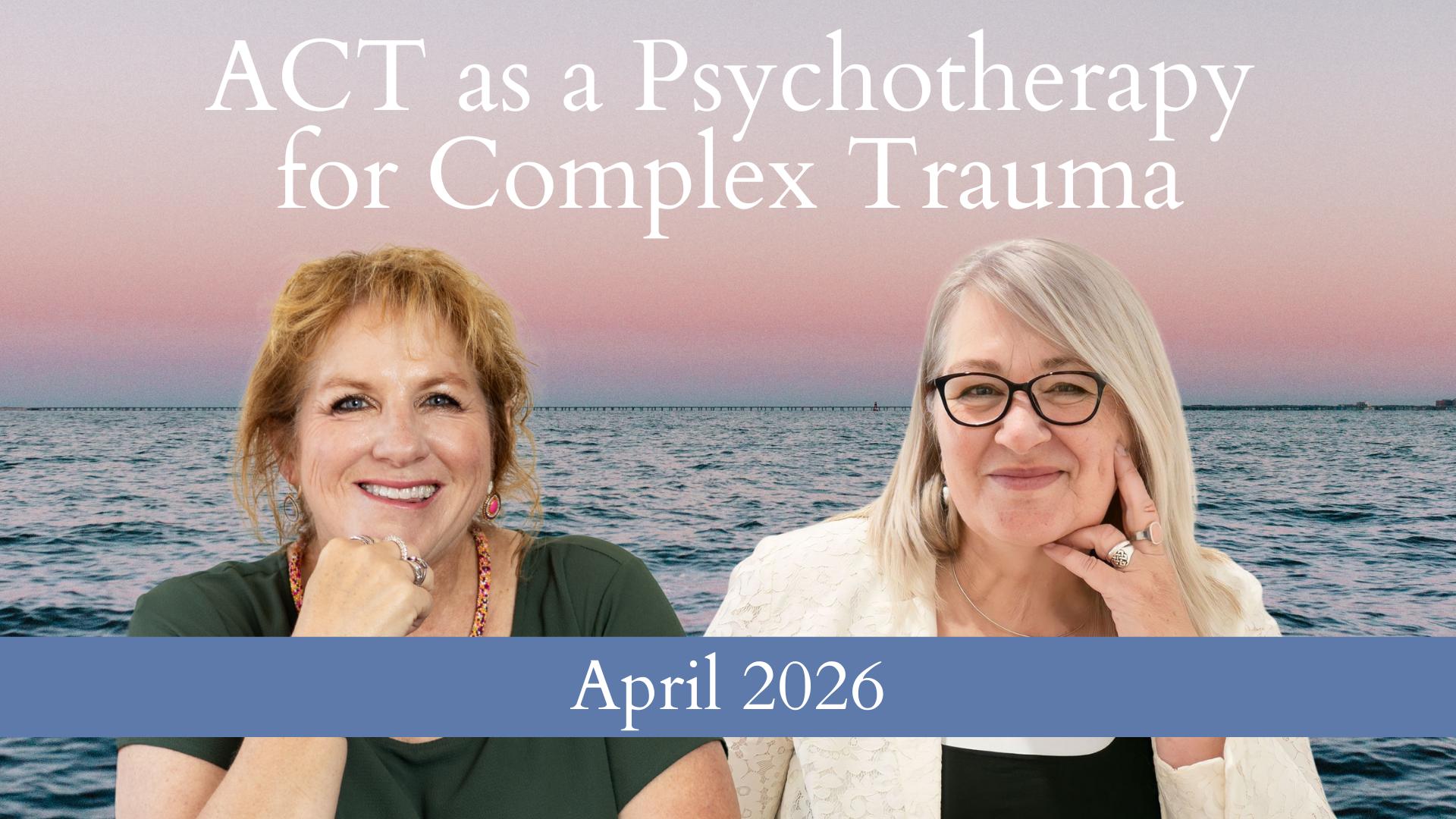
Do you fancy a deeper dive in a workshop focused on trauma?
I have the pleasure of sharing a workshop with Robyn D. Walser, a master therapist on working with trauma.
- The first session, led by me, will focus on development and trauma: how our earliest experiences shape the responses we carry into adulthood.
- The second session will be led by Robyn, who will take us on a deep dive into changing adult lives.
I hope you'll join us. Click here to find out more, or email me if you have questions.
With kindness,
Louise
Louise Hayes, PhD
(1). Hayes, L. L., Ciarrochi, J. V., & Bailey, A. (2022). What Makes You Stronger: How to Thrive in the Face of Change and Uncertainty Using Acceptance and Commitment Therapy. New Harbinger Publications. https://play.google.com/store/books/details?id=00iKzgEACAAJ
(2). Herrmann, E., Call, J., Hernàndez-Lloreda, M. V., Hare, B., & Tomasello, M. (2007). Humans have evolved specialized skills of social cognition: the cultural intelligence hypothesis. Science (New York, N.Y.), 317(5843), 1360–1366. https://doi.org/10.1126/science.1146282